
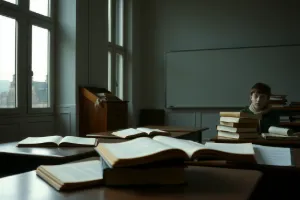
Yannick Haenel Wins 2026 Prix Femina for Novel Exploring the Loneliness of Teachers
November 4, 2026 | France | Literary News
French writer Yannick Haenel has won the 2026 Prix Femina for his novel La solitude des professeurs est infinie (The Loneliness of Teachers Is Infinite), a work exploring the emotional challenges of teaching, the struggles of young educators, and the transformative power of literature.

Published by Gallimard in August 2026, the novel follows Jean Deichel, a young trainee French teacher assigned to a challenging middle school in Mantes-la-Jolie, a suburb northwest of Paris.
Through Jean's experiences in the classroom, Haenel examines the gap between the idealism that inspires people to become teachers and the difficult realities they encounter in the education system.
The novel explores professional isolation, classroom tensions, institutional neglect, and the struggle to maintain a sense of purpose in an increasingly demanding environment. At the same time, it presents literature as a source of inspiration and a powerful means of helping young people understand themselves and the world around them.
A Young Teacher Confronts the Reality of Education
At the heart of La solitude des professeurs est infinie is Jean Deichel, a young man who enters the teaching profession with considerable enthusiasm and a strong belief in the value of education.
His first teaching experience, however, is far removed from his expectations.
Assigned to a middle school in Mantes-la-Jolie, Jean encounters the everyday difficulties of working in a challenging educational environment. Maintaining classroom discipline, connecting with students, and dealing with institutional pressures gradually test his original enthusiasm.
The novel portrays teaching as a profession filled with contradictions. Teachers are expected to guide young people, encourage independent thinking, and provide emotional support, yet they often face limited resources, insufficient recognition, and a lack of institutional assistance.
Jean's experiences reveal the emotional burden that can accompany these responsibilities.
Despite the difficulties, he continues to search for meaningful moments in the classroom. A successful lesson, an unexpected response from a student, or a moment when literature genuinely captures a young person's attention can make the struggle worthwhile.
Through these experiences, Haenel presents teaching not simply as a profession, but as a deeply personal commitment that can bring both frustration and fulfillment.
Can Literature Change the Lives of Young People?
One of the novel's central themes is the relationship between literature and education.
For Jean, teaching French is not merely about explaining grammar, preparing students for examinations, or completing the official curriculum. He believes that books can introduce young people to experiences, emotions, and perspectives they might never encounter in their everyday lives.
In some of the novel's most memorable classroom scenes, Jean introduces students to writers and literary works beyond the standard school curriculum.
His teaching includes readings of Charlotte Delbo, the French writer and Holocaust survivor whose work explores memory, suffering, and human survival.
These moments reveal a different understanding of education. Literature becomes more than an academic subject; it becomes a way for students to encounter unfamiliar worlds, question established ideas, and develop a deeper understanding of human experience.
For young people growing up in difficult circumstances, access to literature can open intellectual and emotional possibilities that extend far beyond the classroom.
Haenel suggests that a teacher's influence cannot always be measured through examination results or immediate academic achievements. Sometimes, a single lesson or a book introduced at the right moment can leave a lasting impression on a student's life.
A Novel Inspired by the Author's Own Teaching Experience
La solitude des professeurs est infinie draws significantly on Haenel's personal experiences.
Before becoming widely recognized as a novelist, Haenel worked as a literature teacher in a Parisian suburban middle school for many years. He has spoken about the difficulties of the profession, particularly the growing pressures on teachers and the feeling of being insufficiently supported by the education system.
This background gives the novel a strong sense of authenticity.
Jean Deichel can be understood as a fictional